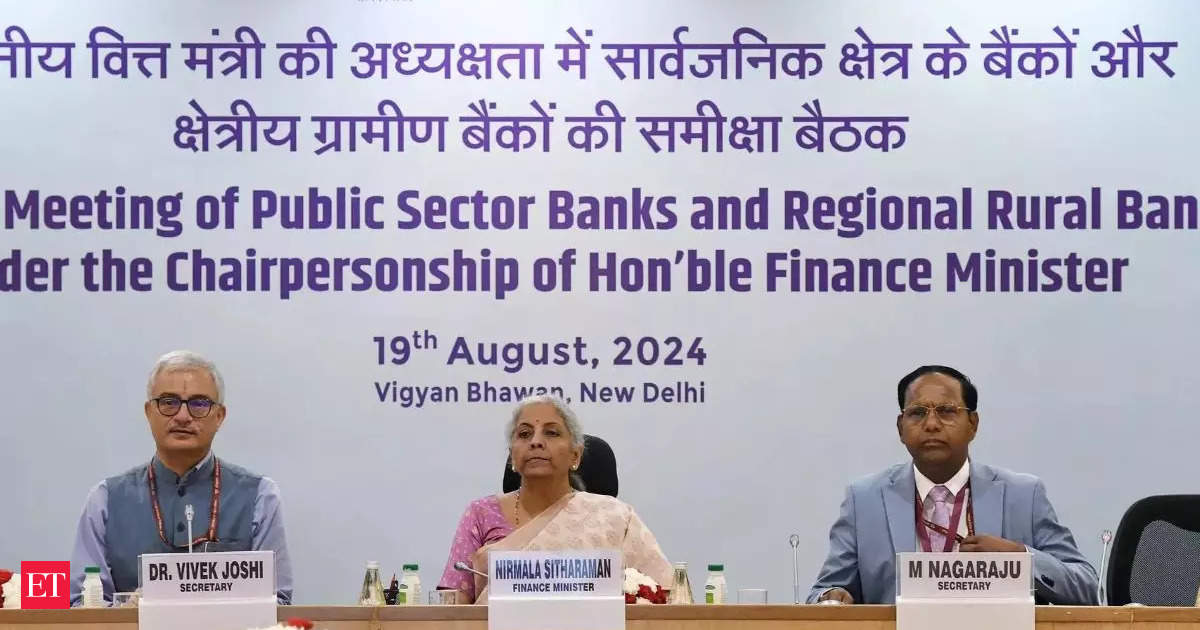
During the review, Sitharaman emphasised the need for PSBs to undertake special drives to boost deposit collections and to enhance customer service, particularly in rural and semi-urban areas. She highlighted the importance of banks connecting with customers more effectively and providing efficient service delivery.
The Finance Minister also stressed the importance of a collaborative approach involving banks, the government, regulators, and security agencies to combat fraud and mitigate cybersecurity risks.
In addition, Sitharaman urged banks to quickly implement recent Budget announcements, including a new credit assessment model for MSMEs that leverages digital footprints and cash flows. She also instructed banks to increase credit flow to beneficiaries under schemes such as the PM Surya Ghar Muft Bijli Yojana and PM Vishwakarma Yojana.
During the meeting it was noted that during FY24, the PSBs performed well across all financial parameters as evidenced by improved asset quality with Net NPAs (NNPAs) declining to 0.76 per cent, sound capital adequacy of the banks at 15.55 per cent, Net Interest Margin (NIM) of the banks at 3.22 per cent, and highest ever net aggregate profit of Rs. 1.45 lakh crore with the dividend of Rs 27,830 crore to the shareholders. Improvements over various parameters have also enhanced the ability of PSBs to raise capital from the markets.
Deposits have been growing 300-400 basis points lower than the credit growth in the last few months, creating an asset-liability mismatch for banks.
The State Bank of India (SBI) in its latest report noted that the belief that the deposit growth in the banking sector is flagging is just a statistical myth.
However, the report highlighted that, while it’s true that credit growth has outpaced deposit growth in recent years, leading some to trumpet this as a sign of decelerating deposit activity, a deeper analysis reveals a different story.The report highlighted that in FY23, the banking sector, particularly All Scheduled Commercial Banks (ASCBs), registered the highest absolute growth in both deposits and credit since 1951-52.
RBI governor Shaktikanta Das commented on the deposits trailing loan growth.
“It is observed that alternative investment avenues are becoming more attractive to retail customers and banks are facing challenges on the funding front with bank deposits trailing loan growth. As a result, banks are taking greater recourse to short-term non-retail deposits and other instruments of liability to meet the incremental credit demand.”
He said that this might expose the banking system.
“This, as I emphasised elsewhere, may potentially expose the banking system to structural liquidity issues. Banks may, therefore, focus more on mobilisation of household financial savings through innovative products and service offerings and by leveraging fully on their vast branch network.,” he added.
Das added that there were segments of personal loans that showed high growth rate.
“It is observed that the sectors in which pre-emptive regulatory measures were announced by the Reserve Bank in November last year have shown moderation in credit growth. However, certain segments of personal loans continue to witness high growth,” said Das.
“Excess leverage through retail loans, mostly for consumption purposes, needs careful monitoring from macro-prudential point of view. It calls for careful assessment and calibration of underwriting standards, as may be required, as well as post-sanction monitoring of such loans,” he added.
Das added that share of bank deposits have declined with households allocating savings to mutual funds funds and pension funds.
“While bank deposits continue to remain dominant as a percentage of financial assets owned by households, their share has been declining with households increasingly allocating their savings to mutual funds, insurance funds and pension funds. To be precise, households are increasingly turning to other avenues for deploying their savings instead of banks.”